
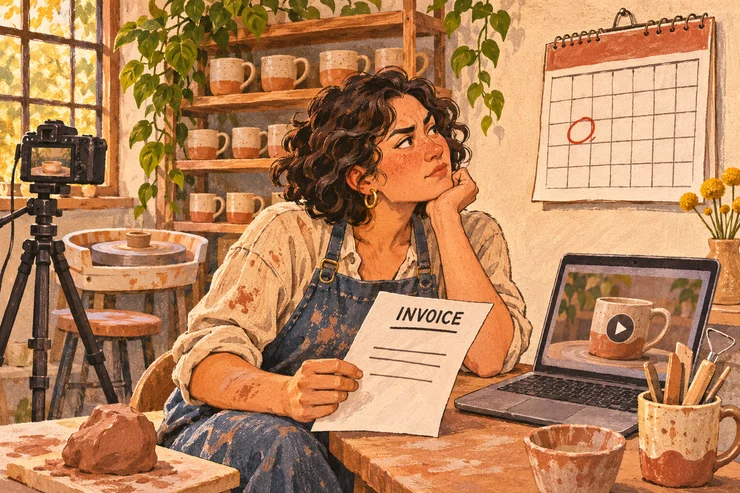
The sponsor approved your video. You published it, sent the invoice and moved on to the next upload. Now the payment date has passed, and you’re still opening your banking app to check.
Start by checking the agreed due date and confirming that the company has everything it needs to pay you. Then ask for a specific payment date. An invoice missing from finance needs a different response from a sponsor disputing the work or repeatedly breaking a promise to pay.
Here’s how to find out which problem you have, with an email you can adapt.
Check who’s paying and when payment is due
Open your agreement and find the company responsible for paying you. It might be the brand, or it might be the agency that arranged the sponsorship. The logo in your video doesn’t settle that question.
Then check what starts the payment clock. Is it publication, approval of the work, or receipt of your invoice? “Net 30” tells you the length of the wait, but you still need to know when those 30 days begin.
Suppose you agree to payment 30 calendar days after invoice receipt. Your video goes live on 1 September, but the company receives your invoice on 5 September. Payment is due on 5 October. Counting from the upload date would send you chasing four days early.
Check that you’ve completed the work that triggers payment, including any agreed extras such as a Short or campaign report. If your deal includes performance pay, check its dates separately from the fixed fee. You might be owed the fee for making the video while a view-based bonus is still being calculated. Our guide to how sponsorship deals pay explains those arrangements.
If you agreed everything by email, keep that thread as evidence of what you settled. If no payment date was agreed, ask: ‘The work is complete and I’ve submitted invoice [number] for [amount]. Please confirm when payment will be made.’
Local law may also set a deadline: the UK’s commercial-payment rules, for example, cover cases where no date was agreed. You don’t have to wait indefinitely for the company to choose one.
Find out whether finance has your invoice
The person approving your video and the person paying your invoice may be in different teams. Accounts payable is the name for the team that handles supplier bills. A cheerful “Looks great, thanks!” from your campaign manager doesn’t tell you whether that team has received anything.
Look for invoicing instructions in the contract, onboarding emails or creator help centre. If you haven’t sent an invoice and the agreement requires one, submit it now and confirm receipt. Supplier registration means setting you up in the company’s payment system, which can include your business, bank and tax details. Confirm the portal or contact with someone you already know before sharing those details.
Gaming sponsorship company Wehype’s instructions give a concrete example. Wehype requires both an emailed invoice and payment details registered in Tipalti, its payment platform. It also directs invoices and payment questions to different inboxes. Check that your reminder is going to the right one.
Use the follow-up below to check what’s missing; you don’t need a separate email for every question. If the company asks you to correct the invoice, clarify the required change and payment date in the same exchange. Your agreement may tie payment to receipt of a valid invoice, so resolve that point rather than assuming the old date still applies or automatically accepting a new one.
Send a specific overdue-payment email
Use the company’s payment-support route if it has one. Otherwise, send the follow-up to your campaign contact, copying the finance contact if you have one. Reattach the same invoice so nobody has to hunt through an old thread. Keep its number and date when resending it; you’re following up on an existing bill.
Use this message when payment is overdue. If you’re still establishing the due date, change the subject to ‘Payment date for invoice [number]’ and ask for confirmation instead.
Subject: Overdue invoice [number] · [campaign name]
Hi [name],
I’m following up on invoice [number] for [amount and currency], which was due on [date]. I originally sent it on [date] and have attached it again here.
The agreed work is complete: [video link and any other deliverables].
Could you confirm that the invoice has been received and approved, and let me know the scheduled payment date? If anything is missing, please tell me what you need and who in finance I should speak to.
Thanks, [Your name]
Put a reminder in your calendar for two or three working days later, or use the company’s published support response time. If there’s still no reply, follow up and bring in finance or official support at that point. You don’t need to send a week of unanswered emails to the same person first.
Use their answer to decide the next step
“It’s with finance”
Ask what that means for your invoice. Has someone approved it, and which payment date is it scheduled for? Request an introduction to the person handling it if your contact can’t answer.
A reply saying the transfer is scheduled for Friday gives you something to follow up on. “Processing” on its own doesn’t.
If finance cites standard 60-day terms when your agreement says 30, send the agreed clause and ask it to resolve the mismatch.
“We’ve already paid”
Ask for the date it was sent, the payment method and the transfer reference or receipt. Check that the payer used the payment details you supplied. Then ask your bank or payment provider to investigate with the reference; the payer may also need to trace the transfer from their side.
“The brand hasn’t paid us yet”
If an agency arranged the deal, go back to the payment clause. Does it promise payment by a set date, or tie your payment to money arriving from the brand?
Point to the agreed terms and ask the agency for a date. If it says it must wait for the brand, ask when that payment is expected and what happens if it doesn’t arrive. If you can’t resolve what the clause means, take it to a freelancer legal-advice service or a lawyer who handles commercial contracts.
Chase the company responsible under your agreement. Asking the featured brand to pay you directly can complicate matters if it has already paid the agency.
“The video didn’t perform as expected”
Ask which requirement the sponsor believes you missed. Compare that with the agreement, brief, approvals and delivered video.
Discussing an expected view count when pricing a video is different from promising a minimum number of views. Read the actual wording, including promises made by email. If you agreed to a guarantee, check what happens on a miss, such as an extra integration or a fee reduction. If the disagreement concerns only part of the fee, ask for the undisputed amount to be paid while you resolve the rest.
A promised date passes, or nobody answers
Follow up in the same thread, referring to the promise:
Hi [name],
You confirmed that invoice [number] for [amount and currency] would be paid on [date]. I haven’t received it yet.
Has the transfer been sent? If so, please share the payment reference. If not, what’s holding it up, and what date will it be sent?
Thanks, [Your name]
If your contact doesn’t respond, move the question to finance, their manager or the company’s official payment-support route. Agency Influencer.com, for example, provides a support form for creators who haven’t heard from their campaign representative within two working days. That gives you another route when the person running your campaign is away or has left the company.
When another reminder isn’t enough
If finance or a manager also ignores your follow-up, misses its promised date or refuses payment over a dispute you can’t resolve, start looking into help recovering the debt. You can do this while keeping the conversation open.
Put the agreement or deal emails, invoice, proof of submission, approvals, evidence of delivery and payment promises in one folder. Add a short timeline so someone helping you can understand the case quickly.
Look for a local small-business payment service or freelancer support organization first. For example:
- In the UK, eligible small businesses with unresolved payment disputes against larger customers can ask the Small Business Commissioner for free, confidential help.
- In New York State, check whether the Freelance Isn’t Free Act covers your work. The state’s guidance links to the Attorney General’s complaint route.
A next step can be a written demand setting out the debt and a deadline for payment before further action. Check the applicable procedure before sending one; the required wording, notice period and court route depend on the case.
A commercial lawyer or freelancer legal-advice service can help, especially with an overseas payer. Ask about costs before committing to collection or court action. The government money-claim guide for England and Wales is one starting point and links to separate procedures elsewhere in the UK.
Check your contract and local rules before adding interest or late fees. Some places provide statutory rights, such as the UK’s rules for late commercial payments, so the contract isn’t the only thing to consult. Use the applicable rules rather than choosing a charge yourself.
Before taking the video down, check whether you agreed to keep it live. Taking it down to force payment could create a second dispute over your own delivery. Get advice before using that as leverage. You can decline new campaigns while the old bill remains unpaid.
Make the next deal easier to collect
Before filming the next sponsorship, get the billing contact, complete any supplier setup and settle the payment trigger and deadline. Sponsorship coach Justin Moore recommends discussing split payments. Getting part of the fee before delivery reduces how much finished work remains unpaid at the end.
For today’s invoice, send the follow-up with the paperwork attached and put the next chase date in your calendar.