
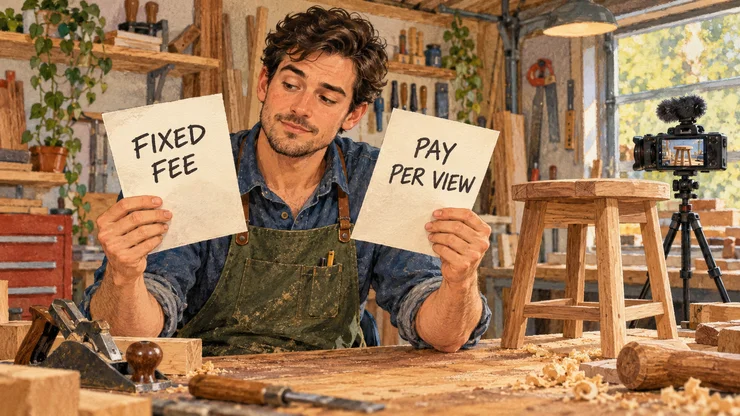
One sponsor offers $1,000 for a sponsored segment in your next YouTube video. Another offers $25 for every 1,000 views. Which would you take?
At 40,000 views, both offers pay the same. But what happens if the video gets 20,000 views, or 100,000? And does the second sponsor keep paying as the views roll in?
Sponsors can pay a fixed fee for agreed work, pay according to views or customer actions, or combine a fee with performance pay. This is money you negotiate with the brand or its agency, separate from the advertising revenue YouTube pays you.
The useful comparison is what you earn for delivering the work, what can change your payment or workload, and when payment is due. Here’s how to read those offers.
A fixed fee and a CPM aren’t necessarily opposites
A fixed fee is an agreed amount for delivering the sponsored content. If that amount is $1,000, a quiet launch doesn’t reduce it. Later, we’ll look at what changes when a sponsor also asks you to guarantee views.
CPM means cost per thousand views. Here, it describes what a sponsor pays for reaching your audience. Brands use it in two ways that are easy to confuse.
First, it can help set a fixed price from expected views. Suppose you and a sponsor expect 40,000 views and use a $25 CPM to value the sponsored segment. That produces a $1,000 quote. If you agree to that as a fixed fee, the view estimate helped you reach a price; it isn’t a running meter on your earnings.
Second, a sponsor can offer to pay based on actual views after publication. At $25 per thousand views, your payment rises with the count. Now the period being measured and any payment limit matter as much as the rate.
So when a brand quotes a CPM, ask: “Are we agreeing on a fixed fee, or will you calculate my payment from the video’s results?”
What happens when the video does better or worse?
Let’s compare two example offers for the same 60-second sponsored segment, often called an integration. Both ask for the same work and let the brand use the video in the same ways:
- Offer A: $1,000 fixed fee.
- Offer B: $25 per 1,000 views in the first 30 days, with no minimum payment and a $2,000 maximum.
| Views in the first 30 days | A: fixed fee | B: pay per view |
|---|---|---|
| 20,000 | $1,000 | $500 |
| 40,000 | $1,000 | $1,000 |
| 100,000 | $1,000 | $2,000 |
Offer B pays more once you pass 40,000 views. But it stops growing at 80,000 views, when you reach the $2,000 cap. A breakout video can keep finding viewers without adding another dollar to that payment. Views arriving after day 30 don’t count either.
The brand pays less for a quiet launch and knows its bill can never exceed $2,000. You take on the chance of earning less than $1,000 in exchange for the chance of earning more.
Does the window fit your videos?
Artist and YouTube creator Kelsey Rodriguez explained her preference for flat fees in a 2023 video about her brand deals. Some of her videos found large audiences three months, six months or a year after publication. For videos that grow that way, a 30-day window leaves out much of the audience the sponsor eventually reaches.
Look at how similar videos on your channel gather views. If most arrive in the first two weeks, a 30-day window captures that initial audience. If your tutorials keep bringing in search traffic for months, show the sponsor that history when asking for a fixed fee or a longer window. Their segment keeps reaching new viewers alongside your video.
Before accepting, pin down four things: the view count you’ll use, the cutoff date, the minimum fee and the maximum payment. If payment depends on a YouTube Studio report, agree on which report you’ll send.
A view guarantee adds another obligation
Expecting 40,000 views is different from promising 40,000 views. A fixed-fee offer can still include a minimum view requirement and a consequence for missing it.
Talent agency Digital Fox gives a concrete example in its brand-facing guide to guaranteed views. It describes agreeing in advance to one of two remedies: publish more sponsored content until the target is reached, or adjust the fee in proportion to the views delivered.
If your own agreement requires an extra integration when a video misses its target, your fee for one segment could become the fee for two. That’s another script, another approval round and another sponsor slot in your upload schedule.
Ask whether a target is a forecast or a commitment, and when it will be measured. If it’s a commitment, settle what happens on a miss. Would you owe one extra segment, several, or a refund? A fixed number on the invoice doesn’t tell you how much work you’re taking on.
Commission pays for customers, not just viewers
With commission, you earn when viewers take an agreed action. That could be a purchase, a paid subscription or a qualifying signup. A sponsor might pay a percentage of the sale or a fixed amount per customer. At 10% commission, an eligible $100 purchase earns you $10.
A hybrid deal combines a base fee with performance pay. The base pays for the agreed work; the additional earnings depend on results.
Creator Jay Clouse raised a familiar worry in a Creator Science conversation: what if a brand pays a fixed fee and is disappointed by the sales? He liked the way affiliate pay tied his earnings to the brand’s results. Sponsorship coach Justin Moore suggested a hybrid. Making the video is work in its own right, so a base fee pays for that; commission rewards the sales that follow.
For example, suppose the offer is $500 plus $20 for each approved new customer. With no customers, you earn $500. With 25, you earn $1,000. With 50, you earn $1,500.
Compared with a $1,000 fixed fee, that hybrid needs 25 approved customers just to match it. Have similar recommendations brought you that many customers before? A view count alone can’t answer that question.
Which sales will count?
Start with the action the sponsor pays for. Does someone need to start a free trial or become a paying subscriber? Do existing customers count, or only new ones? “$20 per customer” needs a definition you can both work with.
Then check how the purchase gets credited to you. One approach is the last-click rule described by impact.com: the final referring partner gets the credit. Someone could discover a product through your video, then buy through another creator’s link. You helped introduce the product, but the other creator earns the commission.
Ask which credit rule the sponsor uses, then check:
- The purchase window: how long after clicking can someone buy and still earn you a commission?
- Links and codes: does using your discount code credit the sale to you, even without a link click?
- Final sales: can returns or cancellations remove a commission you’ve already seen in the dashboard? Kit’s affiliate program, for example, can deny a commission after a referral is canceled and refunded.
Get access to the results too. You need to be able to see which sales the sponsor has credited and approved.
If you’d like to try earning commissions outside a negotiated sponsorship, our YouTube affiliate marketing guide explains where to find programs and get started.
Which arrangement should you propose?
For substantial work made specifically for a sponsor, start by seeking a fixed fee or a base payment that makes the work worthwhile. That’s especially useful when you don’t yet have sales results from similar offers. You still have to plan, film and edit if nobody buys.
Performance pay becomes easier to evaluate when you have relevant results to work from. For view-based offers, compare weaker and stronger launches within the proposed window. For commission, look at how many customers your recommendations have brought to similar products.
Check the maximum as well as the low outcome: a low minimum paired with a low cap gives you little upside in return for taking the risk.
Keep the work comparable too. An offer that adds a separate Short, permission to run your video as an ad or a restriction on working with competitors asks more of you than an integration alone. Those terms belong in the price discussion even if both sponsors quote the same CPM.
When will the money arrive?
The counting window tells you when results stop being measured. The payment terms tell you when the resulting fee is due. “Net 30,” for example, means payment is due within 30 days, but you still need to agree on what starts that clock.
Suppose the sponsor counts views for 30 days, you submit the final invoice at that point, and payment is due 30 days after invoicing. The payment deadline is around day 60, not day 30.
For a fixed fee, ask whether you can invoice when you publish or whether you’re waiting for the brand to approve the work. For commission, ask when sales become final and which payout cycle they’ll go into.
Justin Moore’s guide to sponsorship payment delays also recommends discussing split payments and checking the brand’s invoice process. You can ask for part of a fixed fee at signing and the balance on delivery. Sort out the payment paperwork early too, so it doesn’t hold up an otherwise agreed payment.
Before accepting, you should be able to finish three sentences:
- For delivering the agreed work, I earn…
- My payment or workload changes if…
- Payment is due…
If one of those is still unclear, you’ve found the next question to send the sponsor. Our guide to responding to a sponsorship offer can help you put that reply together.