

Brands don’t sponsor videos to reward good work. They pay to put a product in front of people likely to use it, in a video that gives those people a reason to care. A bigger channel helps, but it doesn’t answer a basic question: why would our customers be watching you?
Answer that question before you contact anyone. Find brands whose products your viewers have a genuine use for, then approach them with a specific video idea. Some brands will reach out to you first, and that’s worth preparing for. You don’t have to wait for it.
1. Check whether you can make the case yet
A paid sponsorship means a brand pays you to feature its product. The feature might be an integration, which is a segment inside one of your regular videos. It might also be a dedicated video built around the product.
Two other arrangements sometimes get called sponsorships:
- A gift is free product. It may come with a request or an obligation to post about it.
- An affiliate deal pays commission when viewers buy through your link.
Either can be worth having. But on its own, neither one gives you an agreed cash fee for making the video.
No single subscriber count makes a channel ready. Brands that publish their criteria tend to weigh several things together. Elgato’s sponsorship requirements, for instance, describe judging channel size, content type, persona and target audience case by case. Some programs do set their own minimums.
For a first deal, readiness mostly comes down to three things you can check today:
- You can say who your viewers are. “Photographers who want to make videos of their trips” is useful. “Photography fans” is too vague to help a brand.
- You have relevant work. You need several videos where a product could appear without derailing the content. One lucky upload isn’t a pattern.
- You have comparable numbers. YouTube’s guidance on brand deals suggests showing your channel’s performance and audience. Compare several recent videos in the format you’d pitch over the same period, such as their first 28 days. Include the ordinary performers, because a brand wants to know what a typical video does.
Put that on one page with your channel link, avatar, a few recent video thumbnails and a business email. Add useful audience details from YouTube Analytics, such as age and top countries. That’s your media kit, and its only job is to make your case quickly. Link each thumbnail to the video so a brand can watch your work.
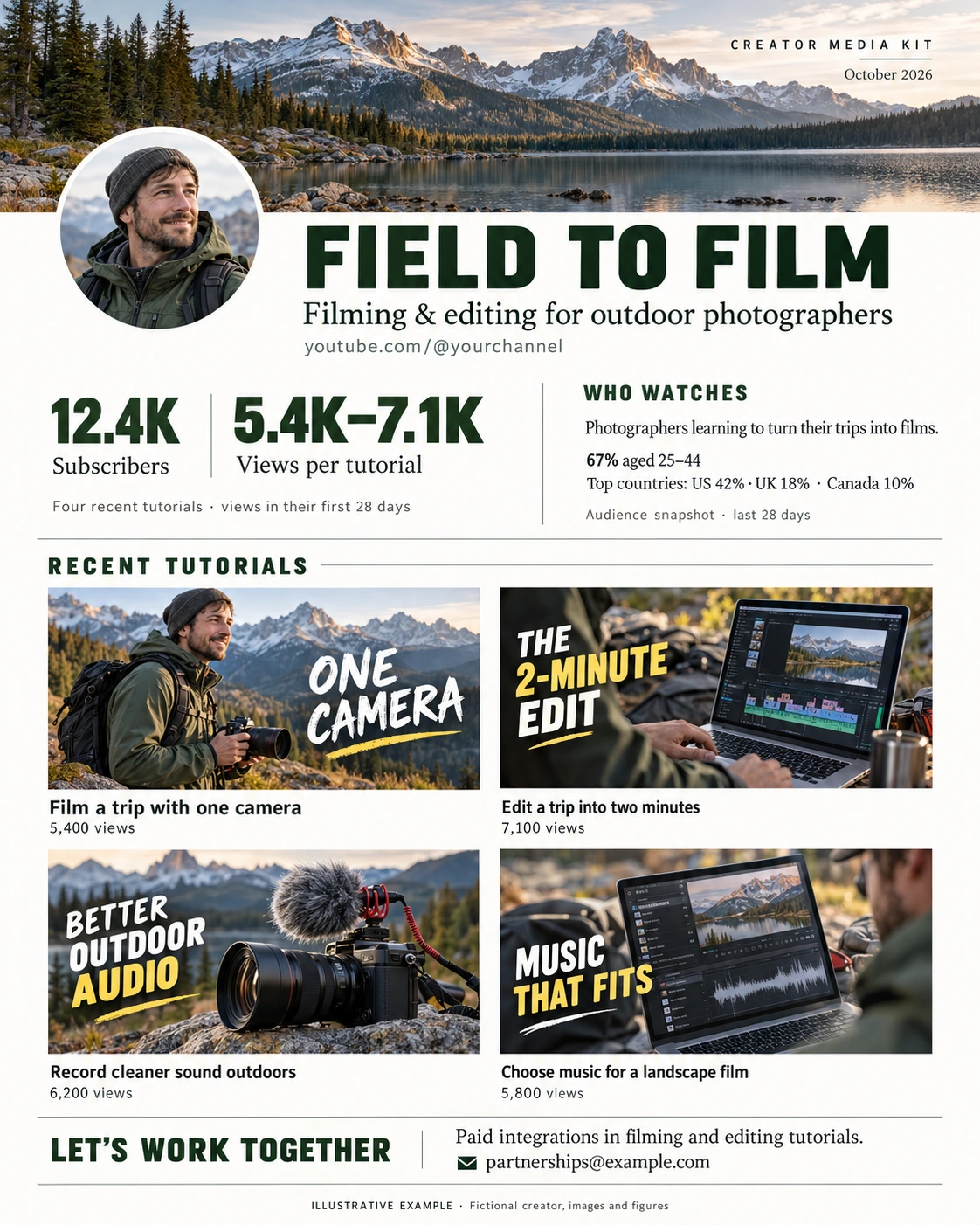
For real examples, see Jason Vong’s media kit and The Knotty Garden’s kit. Both put the creator, audience and work within easy reach.
Then decide. If you can fill the page, start approaching brands. If something is missing, work on that first. You might need two more tutorials in the format you want to pitch, or more recent uploads to show a typical range. A specific gap gives you something to fix. “Not big enough yet” doesn’t.
2. Know how sponsorship conversations start
Sponsorships usually begin in one of three ways:
- A brand, or an agency working for one, contacts you.
- You contact a brand.
- Someone you already know at a brand, such as a PR contact who sent you products, talks with you about a paid campaign.
You can’t control the first route, but you can make it easier. Jess Delight, reviewing her 2022 income, says that was her first year of paid sponsorships. She says the sponsors who paid her had contacted her, while her own outreach didn’t turn into paid deals. She also counts those deals separately from gifts she accepted. If a brand might come looking for you, help it get there. List a business email on your channel, and say plainly in your channel description who the channel is for.
The third route is easy to miss. Kimberly Cherrell advises established creators to test the products PR contacts send them. If they like a product, they can go back to that contact and ask about a campaign. The gift isn’t the payment. What it gives you is a person who already knows your channel and a product you can judge honestly.
Agencies and matching platforms sit in between. YouTube’s Creator Partnerships program helps eligible creators and brands find each other. Treat an inquiry through any of these like any other offer: check who the brand is and what’s actually on offer.
The rest of this guide focuses on the second route, because it’s the one you can start today.
3. Find sponsors on channels your viewers already watch
Start your list with brands that already sponsor channels close to yours. A documented sponsorship shows that a brand has worked with that kind of channel before. It won’t tell you what the brand spends now, and the other creator’s pitch isn’t yours to copy. It does give you a real name to research.
Landscape photographer Adam Gibbs is a useful example. Each of these videos names its sponsor in the description:
| Video | Sponsor | What it sells | Where a viewer might use it |
|---|---|---|---|
| Winter Light in the Canadian Rockies (Feb 11, 2026) | Storyblocks | Stock footage, music, templates | Editing their own videos |
| Winter Photography in Extreme Cold (Apr 1, 2026) | Squarespace | Website builder | A portfolio, or a site that sells prints |
Treat the last column as a starting point to test against your own viewers. Before a brand goes on your list, check whether your audience has a real use for what it sells.
- The problem
- Adam says filming between photography tours left gaps in his footage.
- The product's role
- He explains that Storyblocks supplied extra footage and music for this video. The message runs over outdoor footage.
- The next step
- The closing frame shows his Storyblocks link, and he points viewers to the description.
The useful lesson is the connection to the work: Adam explains a problem he had and how the product helped. For your own pitch, look for a similarly specific use you can show your viewers.
Sharing a topic won’t settle that. Picture two photography channels. One teaches photographers to film and edit their outdoor trips. The other offers quiet landscape walks. The subject is the same, but people may watch them for very different reasons. Someone who comes to unwind may never open an editing app.
Your comments can help you see what viewers want from you. Imagine the editing channel getting a steady run of questions like “What track is this?” or “How did you make that title?” That would make Storyblocks worth a closer look. A hundred “so relaxing, thank you” comments are lovely, but they suggest looking at different brands.
When the fit holds up, turn it into a video idea. The editing channel might propose Turn your photography trip into a two-minute film. In that tutorial, the creator edits their own footage on screen and picks music and a title template from Storyblocks along the way. A link goes in the description. The product appears at the moment a viewer would reach for it, instead of in an ad read tacked onto the end. That gives a brand something concrete to approve.
Then try the product properly. If a free trial isn’t enough to judge it, ask for evaluation access. You’re about to recommend it to people who trust you.
For this step, find three prospects, either from channels near yours or from our sponsor directory. For each one, write a sentence on why your viewers would care and one video idea. Three gives you options to compare without the research taking over your week.
4. Send a specific proposal to the right place
First, find out how each brand wants to hear from creators. If it publishes a creator program or partnership form, use that. If not, YouTube’s guidance suggests finding a relevant marketing contact. While you’re looking, check two things: how the brand pays, and whether you qualify.
Our two examples show why both checks matter.
Storyblocks has a partnership inquiry form. Its introduction says you need a minimum subscriber count on your chosen platform but doesn’t state the number, so check the current requirements before applying. If you fall short, move on to your next prospect. Storyblocks also has a contributor program, but that’s a different arrangement. It’s for selling your stock media through the library, not for being paid to promote it.
Squarespace runs a public affiliate program that pays commission on qualifying referrals. That can be real income, but it isn’t an agreed sponsorship fee. If you want a fee, you’ll need a different route in, and not every brand offers one.
If a brand has a form, answer its questions in the format it asks for. Use an email when you’ve found a relevant contact, or when a brand writes to you first. Here’s an example written for the hypothetical editing channel:
For the hypothetical editing channel · Replace the details before sending
Subject: Paid partnership idea for outdoor-video editing
Hi [Name],
I run [Channel], a YouTube channel that teaches photographers to film and edit their outdoor trips. [What viewers regularly ask about, if your comments show it.]
My last [number] tutorials in this format reached [view range] views in their first 28 days. [One relevant audience fact.] A recent example: [link].
In [month] I'm making "Turn your photography trip into a two-minute film." I'll edit my own footage on screen and show viewers how to choose music and a title template from Storyblocks, with a link in the description.
Would you consider a paid integration in that video? If you're planning partnerships for that period, I can send an outline and a fuller audience breakdown.
Thanks,
[Name] · [Channel link] · [Business email]
If the brand gives a response timeline, follow it. If it doesn’t, wait a week, send one short follow-up, then turn to your next prospect.
If a brand asks for your rate, ask about the job before naming a number. Is it an integration or a dedicated video? How many revisions? Will they reuse your footage, and for how long? The answers change what you’re being asked to do.
5. Agree the terms in writing
Before production starts, agree the work, the fee, the dates and the rights in writing. That might be the brand’s contract or another written agreement. Whatever form it takes, it should answer these questions:
- Compensation: Is it a fee, product, commission, or a mix? Settle each part separately.
- Deliverables: Is it an integration or a dedicated video? What are the talking points and links? Are there any extra posts?
- Revisions: How many rounds are included, and what counts as a revision?
- Dates: When is the draft reviewed, when does the video publish, and when are you paid?
- Reuse: Can the brand use your footage in ads or reposts? If so, where and for how long?
- Exclusivity: Are you agreeing to avoid competitors? For how long?
Each of these changes the job. More production work, extra revision rounds, the brand reusing your footage and limits on working with competitors all add to what you’re giving. Account for each of them in your quote rather than pricing only the segment viewers will see.
Timing matters for your upload schedule too. Cathrin Manning describes building in extra production time for brand review and revisions. In the arrangement she describes, payment comes after the video is published. Your deal may run differently, so confirm the order before you plan around it.
Finally, tell your viewers. YouTube requires you to turn on the paid promotion setting, which adds a label to the video, and to follow the rules that apply to you and your audience. In the US, the FTC’s influencer guidance makes three points:
- Payment and free or discounted products both count as connections you should disclose.
- A video disclosure belongs in the video itself and should be hard to miss.
- You shouldn’t assume a platform tool is enough on its own.
So mention the sponsor clearly in the video and turn on the setting as well.
6. Get one proposal ready to send
You don’t need a full sponsorship strategy yet. You need one proposal you’d be comfortable sending. Gather your channel evidence, make sure brands can reach you, choose three suitable brands and tailor a message to the strongest fit.
If you get stuck along the way, that tells you something useful. Name the gap: too few videos in the format, a fuzzy description of your audience, or no product your viewers would really use. Fix that first, then come back to the pitch.
- One sentence on who watches and why
- Several recent similar videos compared over the same period (for example, their first 28 days)
- Business email and channel description easy to find
- Three prospects, each with a viewer use and a video idea
- Each brand’s contact route, payment model and eligibility checked
- Product tested before you recommend it
- One tailored proposal sent, with a follow-up date noted