
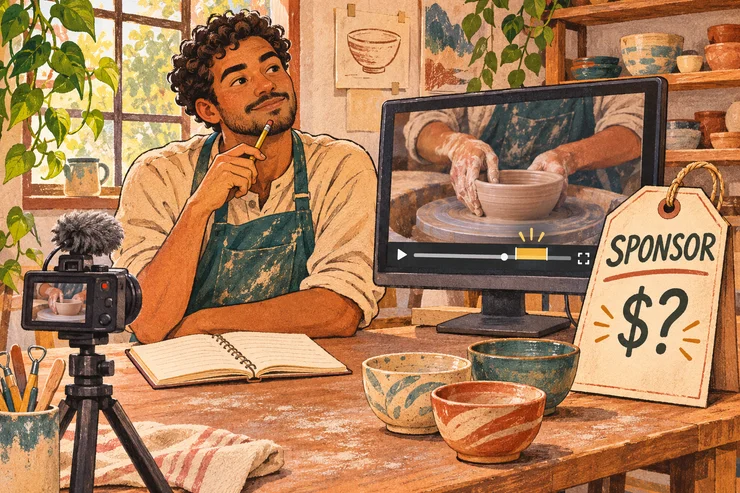
A sponsor asks for your rate. You know how long the video will take to make. You know how many people usually watch. Turning those two things into a price is the unfamiliar part.
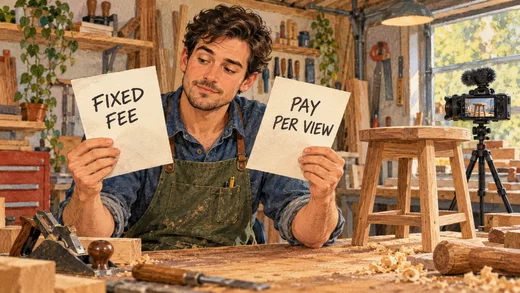
For a starting calculation, suppose your next video is likely to get 30,000 views. At $30 per thousand views, you would charge the sponsor $900 for making and publishing the segment. You could propose that as a fixed fee.
That gives you a number to work with. Next, check it against comparable deals and the work involved. A fee that suits a simple mention might be far too low for a custom demonstration, even on the same channel.
What do real sponsorship rates look like?
Let’s start with an integration: a sponsored segment inside one of your regular videos. Its price is often compared using CPM, or cost per thousand views. This describes the brand’s sponsorship payment to you, separate from the advertising income YouTube pays your channel.
ThoughtLeaders analyzed 9,002 booked YouTube integrations scheduled between August 2024 and August 2026. The median was $36 CPM for channels under 100,000 subscribers and $26 for channels with 100,000–500,000. Across all five size groups, the medians ranged from $17 to $36. Its data mixes long-form and Shorts integrations, so these are broad comparison points for booked placements.
Finance and business sponsorships can command much more. In its predominantly US campaign data, Creators Agency reports a median near $100 CPM for sponsored segments during finance and business videos. About 90% of those deals fell between $50 and $200 CPM. The agency’s figures cover making and posting the segment, with reuse permissions, exclusivity and extra work priced separately.
At 30,000 views, $100 CPM would mean $3,000. If you make finance or business videos for an audience like that agency’s, this is the more relevant starting comparison.
For a first basic integration on a channel below 100,000 subscribers, I’d test $30–$40 CPM against the work and audience fit. That’s a rounded planning band around ThoughtLeaders’ $36 median, not a published market-wide range. Our $30 example uses its lower end. A closely matched creator’s deal or your own successful past partnership should take precedence over this broad starting point.
Define the segment and forecast its audience
For our quote, let’s price a 60–90 second integration with a description link, an agreed outline and one round of feedback before publication.
A dedicated video built entirely around the sponsor’s product is a larger commitment: it takes over the whole upload and needs an idea that can hold viewers’ attention throughout. Quote for that separately.
For the forecast, use recent videos that resemble the one you’re proposing. In YouTube Studio, look at engaged views: views where someone stayed past the opening seconds. Public counters now also count playback starts, so they can show a higher number. YouTube explains both measures.
ThoughtLeaders recommends engaged views for comparison with its historical rates. Use that basis consistently and name it when discussing your forecast with the sponsor.
Open Analytics → Advanced Mode in Studio. You can select an individual video, change the date range and choose the metric. For each video, use the 30-day period starting on its publication date.
Then build your estimate:
- Choose roughly ten uploads in the same format and topic area. Keep Shorts and livestreams separate from regular videos.
- Look at how many views each received in its first 30 days. A video from six months ago has had much longer to gather an audience than last week’s upload.
- Sort the results and look at the middle and the usual spread. Keep comparable weak performers in the sample, too. Removing every quiet upload would make your forecast look better without making the next video more likely to succeed.
Suppose most land between 22,000 and 38,000 views, with a middle result near 30,000. That’s a reasonable forecast to discuss with the sponsor. If you have fewer comparable uploads, show the results you do have and allow for the wider uncertainty.
Expected views ÷ 1,000 × sponsorship CPM = proposed fee.
For our example, that’s 30,000 ÷ 1,000 × $30 = $900. If the brand offers $600 instead, its offer works out to $20 CPM. You now have a useful comparison, rather than two prices floating around without context.
These are views of the whole video, not completed views of the sponsor segment. And a forecast isn’t a promise. You can agree to a fixed $900 fee using a 30,000-view estimate without agreeing to refund money or make another segment if the video falls short. If the sponsor wants a view guarantee, settle that additional obligation explicitly. Our guide to sponsorship payment arrangements explains the difference.
Show why this sponsor should pay your rate
Think about who the brand wants to reach. A tutorial helping small-business owners choose accounting software puts a software company in front of people making a purchase decision. A comedy video with the same number of views offers something different. The audience size is identical; the reason to buy the placement isn’t.
Location matters for the same reason. A retailer that ships only within the US has less use for an audience that mostly lives elsewhere. Show the sponsor the relevant audience information from Studio, alongside your forecast.
Past results can strengthen your case. If similar promotions brought customers to a sponsor, include the results you’re allowed to share. For an awareness campaign, relevant reach and the way you present the product may matter more than immediate sales. Ask what the brand wants the campaign to achieve so you can explain the value in those terms.
Creator Ryan Robinson describes doing this work in his July 2026 sponsorship report. His three-video pitches included concepts, hooks, possible titles and thumbnail ideas. His media kit, the presentation he sends prospective sponsors, showed results from previous collaborations. He reports raising the package’s asking price from $7,500 to $15,000. Buyers could inspect the proposed videos and past results alongside the fee.
For closer price comparisons, ask trusted creators in your niche what their deals included. Artist Kelsey Rodriguez recommends comparing rates with fellow creators. A useful conversation goes beyond the fee: was it one integration or a whole video? Could the brand reuse the footage? What kind of audience was it paying to reach?
Your available slots matter too. If several suitable sponsors want the same upload window, you have a reason to test a higher price. You don’t have to accept the first offer just because the arithmetic works.
Check whether the fee is worth the work
Before sending the quote, work out your own minimum. Include product testing, scripting, filming, editing, feedback and the emails around the deal, plus any outside costs. Sponsorship work takes time even when the video itself was already on your calendar.
Suppose the segment adds eight hours of work and $200 in freelance editing. Valuing your time at $50 an hour gives you a basic work-cost check of $600. Against a $900 quote, that leaves $300 above those costs to contribute to overhead and profit.
The hourly figure is yours to choose. Use what you need to earn for that time, including what other paid work you’d give up. This is a check on whether the total fee works for you; the $900 already includes making and publishing the segment.
Now imagine the same job on a channel expecting 8,000 views. At $30 CPM, the fee would be $240, well below that $600 work check. You’d need to explain why the audience or production is worth a higher flat fee to this buyer. If it isn’t, simplify the segment or pass. Your costs tell you what you can afford to accept; they don’t oblige the brand to pay it.
Your minimum is a private decision about what makes the work worthwhile. Your opening quote can be higher because it also reflects the value of reaching your audience and the demand for your time.
Put a price on the whole request
A base integration can grow into quite a different job once the brand sends its brief. Check these additions before you send a final figure:
- More production: a separate Short, extra versions or another round of reshoots means more work.
- Reuse: ask where the brand would repost your clip or run it as an ad, and for how long. Ask for its separate usage budget and compare that with what creators charge for similar footage and permissions. A short, renewable license gives you a way to test a price without selling unlimited use.
- Exclusivity: define the competitors and dates, then estimate the sponsorship income you’d give up during that period. That lost opportunity belongs in the price.
A month of reposting and a year of paid advertising give the brand very different uses of your work. Price the actual request.
Here’s a concise quote for our $900 integration, with those additions left out:
Hi [Name],
Thanks for the brief. I can offer a 60–90 second integration in my upcoming [topic] video for $900, including the description link, an agreed outline and one round of feedback on the segment before publication.
Recent comparable videos have reached around 30,000 engaged views in their first 30 days. The $900 would be a fixed fee for the work, with no minimum-view guarantee.
I can target [date], provided I have product access and the approved outline by [earlier date]. I’d propose half the fee at signing and the balance within 30 days of publication.
This covers publication on my channel. Brand reuse and exclusivity aren’t included, but I can quote for them if you’d like to add them.
Would that work for your campaign?
[Your name]
If the brand’s budget is lower, look for a smaller version of the job you’d still be happy to take. Sponsorship coach Justin Moore suggests reducing the scope when the budget doesn’t fit. A simple mention could replace a custom demonstration. If you’re discussing a larger package, you could remove an extra deliverable. Recheck the time involved before accepting the new fee.
Keep a note of the scope, opening quote, agreed price and results of each deal. Your next quote can then build on what brands have actually bought from you. If the request is still too vague to price, our guide to replying to a sponsorship offer helps you ask for the missing details.