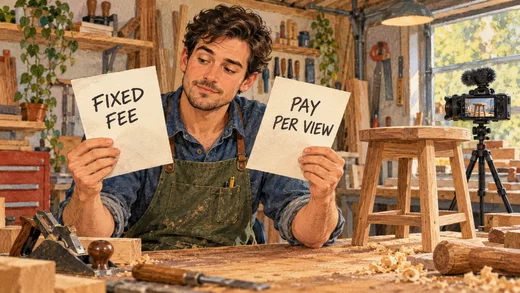

A free product can be a welcome offer. A free product in exchange for a ten-minute YouTube video, two rounds of revisions and a Friday deadline is a job offer. Before deciding whether to accept, find out which one you have.
Accept when the product or expected commission is worth the work you’re promising. If the brand wants you to set aside production time and follow its brief, start by asking for a fee. Commission can go on top, but it won’t pay for that work unless viewers buy.
Is it a sample, an exchange or a sales offer?
“Gifted collaboration” can leave the most important part unstated: do you owe the brand a video?
- A sample with no promised post lets you try the product and decide whether to feature it.
- A product-for-content exchange means you receive the item in return for agreed work, such as a review or sponsored segment.
- A commission-only offer pays you when viewers make qualifying purchases through your link or code. Check whether joining also commits you to specific content.
Don’t promise a positive verdict before you’ve tried the product. If the brand wants a recommendation, agree on a testing stage first: can you decline if it disappoints, and would you need to return it? A review that includes criticism may suit your channel, but confirm that the brand isn’t expecting guaranteed praise.
Offers can combine these arrangements, such as a free product plus commission. Get the requested content, deadline, review process and permission to reuse your footage in writing. A product price and a vague promise to “collaborate” don’t tell you what you’re agreeing to.
Is the product worth your time?
Value the product by what it helps you do or saves you from buying. Its retail price isn’t cash in your account.
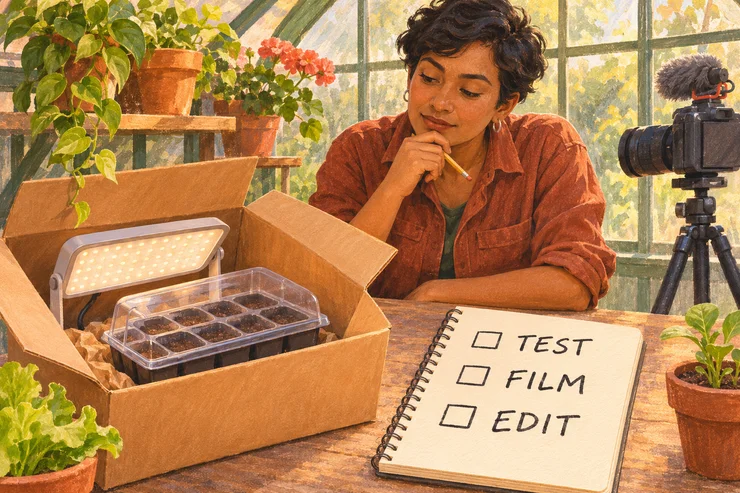
Suppose you make gardening videos and already plan a seed-starting guide. You intended to spend $150 on grow lights. A brand offers suitable lights in return for a short demonstration in the guide, with no separate script approval or extra clips. If that adds little work to the video, the saved purchase could make it a good exchange.
Now add a separate review, a Short and two rounds of revisions. Estimate the extra hours of testing, filming and editing, including time spent on feedback. Compare that work and any costs you’d pay with the $150 purchase you save. If the lights aren’t enough, ask for a fee or offer a smaller package.
Permission to run your footage in ads is another part of the offer. The brand would get an advertisement it can use beyond your upload. Decide where and how long it can run, and price that use separately from making the video.
An item you wouldn’t otherwise buy hasn’t necessarily saved you its list price. You might still enjoy testing it or see a good video in it. Check whether you can keep it, who covers delivery and returns, and whether software access expires after the campaign. A borrowed camera lens can enable a review; it doesn’t become your lens afterward.
A useful sample doesn’t have to buy a video
Audio and video creator Tom Buck’s published policy shows one way to handle this. He buys most equipment himself but also accepts some free products because buying everything would limit what he can test. He discusses his policy with brands before accepting: providing a product guarantees neither a video nor a positive review.
You can propose the same boundary for a product you’re curious about. If the company requires an upload, evaluate it as a content exchange instead.
How many sales would make commission worthwhile?
Commission can fit a recommendation you already want to make. If a product belongs in an upcoming tutorial, adding an affiliate link may involve little extra production work. A commission-only offer is harder to justify when the brand wants a separate video made to its brief.
Suppose you would want $400 for a grow-light segment made to the brand’s brief, and it offers $8 per approved sale instead. Approved means the sale qualifies for payment under the program’s rules, including its cancellation and return terms. You would need:
$400 ÷ $8 = 50 approved sales to match the fee.
Twenty sales would earn $160. One hundred would earn $800. With no sales, you earn no commission. The question is whether you have a reason to expect enough purchases to make the work attractive.
Start with your own results from recommendations of similarly priced products. Look at which videos drove the sales and how long the earnings took to arrive. A grow-light comparison attracts people choosing equipment; a greenhouse tour may attract viewers who simply enjoy looking around.
Check that the brand sells to your viewers’ countries too. Find their locations under Top geographies in YouTube Studio → Analytics → Audience.
If you have no sales history, try a relevant link in content you already plan to make, without promising extra deliverables. Our YouTube affiliate guide explains how to find programs and create those links. Use the resulting sales data to judge larger offers later.
Count commission that will actually be paid
Before accepting, read the program terms or ask the brand:
- What earns commission? A purchase or a paid subscription? Do only new customers count?
- How is a sale credited to you? How long after a link click can someone buy, and does your code credit a sale without a click?
- When is it final and paid? Can returns remove a commission, where can you see approved earnings, and what is the payout schedule?
On affiliate platform impact.com, a pending sale can be reversed before it is finalized, for example if the customer returns the product. Use approved sales when comparing the offer with a fixed fee, and check how long you’ll wait for the money.
Ask for terms that fit the work
You can like the product and still ask for a different deal. Sponsorship coach Justin Moore recommends responding to free-product interest with a specific paid proposal. Give the brand something concrete to consider: what you’ll make, what it costs and how it can use the finished content.
If you only want to try a sample, you could reply:
Thanks for the offer. I’d be interested in testing the grow lights for my seed-starting videos.
I’m happy to try them as a sample, with no obligation to post or meet a publication date. If I feature them, I’ll share my own assessment. Could you confirm that works for you, and whether the lights would be mine to keep?
If the brand wants a segment made to its brief, propose a fee alongside its affiliate offer, with your commitment depending on testing:
The lights could fit my upcoming seed-starting guide. Subject to testing them, I can offer a 60–90 second sponsored demonstration for $[fee], plus your proposed commission on sales. That includes one round of factual corrections to the segment; reuse in your ads would be priced separately.
Do you have a budget for that? If so, let’s agree on draft and publication dates and payment terms before I reserve the slot.
Replace the scope and fee with work you’d actually be willing to deliver. If the budget is too small, offer less: a shorter segment, fewer additional clips or narrower reuse rights. Our guide to responding to a sponsorship offer shows how to clarify the work, schedule and reuse before quoting.
A promise of paid work later isn’t payment for this video. Accept a first exchange because it’s worthwhile on its own. Otherwise, a short reply is enough: “Thanks for considering my channel. I can’t take on the requested video for product and commission alone, so I’ll pass on this one.”
Tell viewers about the arrangement
A product-only deal still needs disclosure. The US FTC’s guidance says to disclose free products when you mention them, even if the sender didn’t require a post. For a video endorsement, make the explanation in the video, not only in its description.
For the sample above, you could say: “[Brand name] sent me these grow lights for free.” If you’re also using an affiliate link, add: “If you buy through my link, I earn a commission.” Put that explanation beside the description link too. Use wording that matches the arrangement you actually agreed.
YouTube also requires the paid-promotion setting in the video’s upload or edit details for branded content and commercial relationships. Its label accompanies your explanation; it doesn’t explain the details for you.
Before replying, write down what you’ll receive and what you’ll promise. For a product exchange, compare its value to you with the full workload. For commission, work out the sales needed and whether you have evidence to expect them. Accept an offer you can justify on those terms, propose a smaller test, or ask for the fee that would make the work worthwhile.