
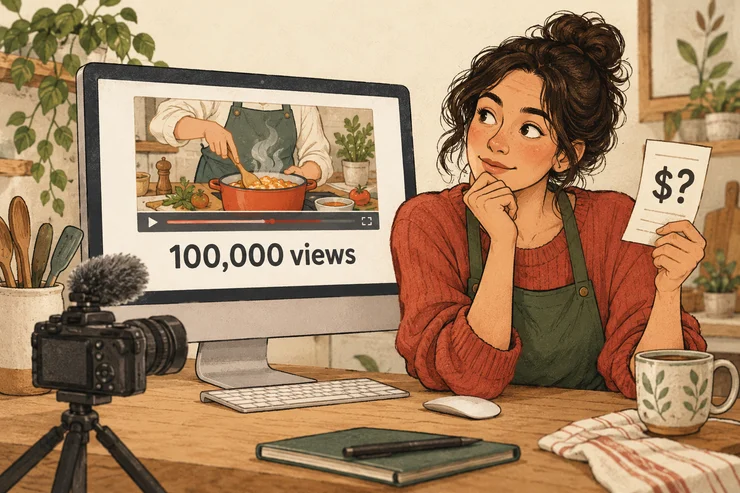
Getting 100,000 views on a YouTube video sounds like it should pay for something. A better microphone, perhaps. Maybe next month’s rent. The payout depends on who watched, what they watched, and whether it was a regular video or a Short.
Three creators who published their numbers reported about $0.50 to $12 per 1,000 views on regular videos. That works out to a small fraction of a cent to just over one cent per view.
YouTube shares advertising and Premium subscription revenue with creators. How much you earn depends partly on what advertisers will pay to reach your viewers, which is why two videos with the same view count can bring in very different amounts.
If you’re already monetized, you can find your own rate in YouTube Studio → Analytics → Revenue → Content performance, then use it to estimate your next video’s earnings. If you aren’t earning yet, we’ll start with what those three creators earned from their channels.
What 1,000, 100,000 and one million views can earn
Creators usually discuss earnings per thousand views. YouTube calls this RPM, short for revenue per thousand views. It measures revenue after YouTube’s share, before your production costs and taxes.
For the calculations here, we use engaged views: views where someone stayed past the opening seconds.
| Channel and report | Per 1,000 views | At 100,000 views |
|---|---|---|
| Brick Experiment Channel: LEGO engineering, 2025 | $0.52 | $52 |
| vidIQ: YouTube education, 2023 report | $3.12 | $312 |
| Clare Johnston: health, wellbeing and skincare, April 2026 report | About $10 | About $1,000 |
At one million views, those rates would produce about $520, $3,120 and $10,000 respectively. At vidIQ’s rate, that’s roughly 0.3 cents a view.
These are very different businesses. Brick Experiment Channel makes LEGO engineering videos and ended 2025 with 5.45 million subscribers. Its low rate still brought in $124,000 from regular videos that year. Johnston describes around 15,000 views and roughly $150 per video. A huge audience can make a low rate add up; a higher rate can bring in more from a smaller audience.
Why the same views can pay differently
Advertisers pay to reach people who might become customers. Some audiences are especially valuable to them, and businesses compete for their attention. That competition can make the same number of views worth very different amounts to a creator.
For ads on regular videos, creators receive 55% of net ad revenue and YouTube keeps 45%. Your RPM already accounts for that split.
Different audiences attract different advertisers
A retailer that only ships within the US wants its ads to reach people who can actually buy from it.
Location can make a striking difference. In its 2023 report, vidIQ reported advertiser spending of $18.88 per 1,000 ad impressions for US viewers, compared with $1.36 for Indian viewers on the same channel. The US audience attracted much higher ad prices.
And it’s your viewers’ location that counts. Moving your recording desk from Mumbai to New York won’t turn an Indian audience into an American one.
Age, household income and parental status also help advertisers choose potential customers. A baby-product brand has a reason to pay for the attention of new parents. A laptop brand offering student discounts is looking for a different group. Both might see “100,000 viewers” and value that audience very differently.
Even the screen matters. Advertisers can target phones, computers, tablets or TVs. A phone-case seller can go further and target a particular phone model. Those choices change which advertisers are bidding to reach the people watching you.
Your niche matters because of the people it attracts
Imagine someone comparing accounting software for a small business. They have a problem to solve and may be about to choose a paid product. Reaching that person could be valuable to several software companies.
A funny animal channel might reach far more people, but they could have little in common beyond wanting a laugh. The software comparison brings together a smaller, more specific group of potential buyers.
That’s a useful way to think about niche: which advertisers want these viewers, and why? Google lets advertisers reach people based on interests, purchase intent and the content they watch. A review, comparison or tutorial can attract an audience with a particular buying decision in mind.
Country and topic also interact. vidIQ found that its YouTube-algorithm video drew more US viewers and higher advertiser prices than a subscriber-growth video watched more heavily in India. Both were YouTube tutorials on the same channel. A niche label alone would have missed the difference.
Longer videos leave room for more ads
A four-minute tutorial can show an ad before it starts. A twelve-minute tutorial has room for an ad partway through as well. YouTube lets creators enable these mid-roll ads on videos of eight minutes or more. When people stay to watch, one video view can create several opportunities to earn ad revenue.
December brings advertisers out shopping too
In the run-up to Christmas, retailers are competing for people who have gifts to buy. YouTube is part of that shopping process: viewers watch reviews, compare products and look for ideas before choosing what to buy.
That competition is good for creators. Advertisers often bid more before holidays, helping make December a strong earning period. Your views don’t have to rise for your revenue to increase; the ads reaching those viewers can be worth more.
Why Shorts earn differently
On a regular video, ads run before or during the video you’re watching. The creator shares in the revenue from those ads.
Now picture scrolling through Shorts. You watch a cooking clip, a football highlight and a comedy sketch, then an ad appears. That ad sits between creators’ videos. Its revenue doesn’t simply belong to whoever posted the clip before it.
Instead, YouTube adds up Shorts Feed ad revenue each month. Some of it covers music licensing. The rest goes into the Creator Pool, which is divided according to each creator’s share of eligible engaged Shorts views in each country. Creators keep 45% of their allocation; YouTube keeps the remaining 55%.
Suppose the pool for one country is $100,000 after music costs:
- Your Shorts receive 1% of the eligible engaged views on monetized Shorts in that country.
- You receive a $1,000 allocation from the pool.
- You keep 45% of that $1,000: $450.
The 45% is only the last step. What each view earns also depends on how much ad money went into the pool and how many views share it.
Brick Experiment Channel reported $0.11 RPM for Shorts, compared with $0.52 for regular videos in 2025. At $0.11, a million engaged Shorts views works out to $110. Its Shorts brought in $66,000 over the year, equivalent to roughly 600 million engaged views at that rate.
Estimate what your own videos could earn
Once you have a rate and its matching view count, the calculation is simple:
Engaged views ÷ 1,000 × RPM = estimated revenue.
Use the engaged views in Studio’s Advanced Mode, rather than the public view counter, which also counts playback starts. Keep the videos and dates the same when matching views to RPM.
If you aren’t monetized yet
Your channel needs to meet the Partner Program’s eligibility requirements, be accepted and enable the relevant ad monetization before its views start earning YouTube ad revenue. For now, you’re estimating what future monetized viewing could earn.
If your videos already get views, you can learn about your audience even if the channel isn’t monetized. Open YouTube Studio → Analytics → Audience. Top geographies shows where your watch time comes from; Age and gender and Device type give you more of the picture.
Start with the kind of videos you plan to make and the people likely to watch them. Keep Shorts separate from regular videos. When looking at another creator’s earnings report, check whether their audience country, subject and video length resemble yours. The biggest channel in your niche isn’t automatically the best comparison.
Then try more than one outcome. For example, suppose you plan regular tutorials and want to see what 100,000 engaged views could bring in. Using vidIQ’s reported rate rounded to $3 RPM, those views would earn $300. Test a weaker outcome too: $1 RPM gives $100. This shows how much your plan depends on getting the higher rate. If you need $300 just to cover production, that difference matters before you start filming.
Our YouTube money calculator lets you change the rate and views without a login. It uses US dollars and is intended for regular videos, not Shorts.
If your channel is already monetized
Open YouTube Studio → Analytics → Revenue → Content performance. Look at the displayed RPM for Videos or Shorts, depending on what you’re estimating.
Choose a recent period and videos similar to what you plan to make. Compare several, rather than relying on your best result. Leave out the latest couple of days because estimated revenue takes time to appear.
If one video’s RPM is much higher, compare its audience countries and length with the others. Check the revenue breakdown too: a burst of membership payments can raise RPM without every video view earning more from ads. For an estimate based only on regular-video ads and Premium earnings, use the Watch Page Ads report: it includes both, without membership payments. Divide that revenue by the matching engaged views and multiply by 1,000 to get the rate.
Keep the period and currency consistent. Don’t apply your current RPM to your lifetime view count: views from before you enabled ad monetization earned no share of YouTube ad revenue. Once you have a sensible range from similar uploads, use that range to estimate the next one.
What the views need to pay for
The revenue still has to pay for making the video. In 2025, cooking creator and cookbook author Carla Lalli Music reported around $10 RPM, but her mushroom pasta video earned $3,665 against roughly $3,500 in production costs. Her own time wasn’t included in those costs.

Your videos may cost much less to make. Put that cost beside the estimate anyway. Knowing that 100,000 views could earn $100 or $300 gives you something concrete to plan around: what you can spend making the video, and how much is left to pay you.